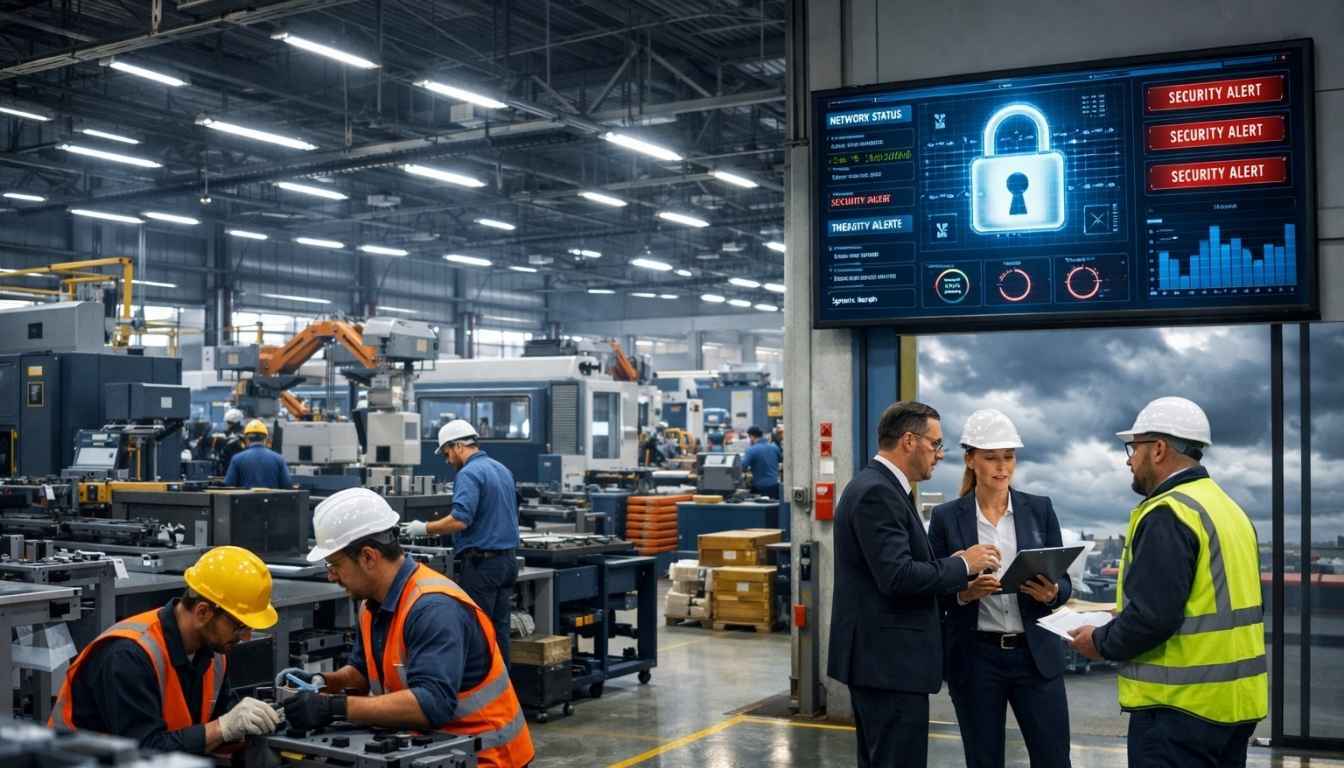
Cyber risk has moved firmly from an IT concern to a board-level issue for UK manufacturers. High-profile incidents, such as the disruption at Jaguar Land Rover, have shown how quickly a cyber event can halt production and ripple across supply chains. For many Midlands-based manufacturers, this has sharpened focus on security, and rightly so.
Recent UK research reinforces the scale of the challenge. A 2026 survey found that 78% of UK manufacturers experienced a cyber incident in the past year, with more than half reporting revenue loss as a result. In many cases, these incidents led to production shutdowns lasting several days, missed customer commitments, and supply chain disruptions. (Infosecurity Magazine)
This is not an isolated issue. The UK Government’s Cyber Security Breaches Survey 2025 found that 43% of businesses experienced a cyber-attack or breach in the last 12 months, underlining how persistent and widespread the threat has become. (GOV.UK)
At the same time, the nature of these threats is evolving. UK businesses faced an average of over 2,000 cyberattacks per day in 2025, as increasingly automated, AI-driven methods made attacks harder to detect and faster to execute. (Beaming)
From Reactive to Proactive: The Real Shift
Despite this, many manufacturing businesses still operate in a reactive position. Incidents are dealt with once they occur, systems are restored, access is regained, and operations resume. But by that stage, the damage has already been done: production has paused, revenue has been impacted, and recovery costs are beginning to accumulate.
The more resilient manufacturers are taking a different approach.
Rather than focusing solely on preventing attacks, they are investing in continuous visibility across their IT environment. This means knowing when unusual activity is happening, identifying vulnerabilities before they are exploited, and understanding system health in real time. It shifts the conversation from “What do we do when something goes wrong?” to “How do we know something is about to go wrong?”
This is where working with an IT support provider strategically becomes critical.
A well-structured managed IT environment introduces continuous monitoring, structured patching, and real-time alerting. It enables businesses to detect attempted breaches, suspicious behaviour, or system anomalies early, often before they escalate into incidents that affect production.
In practice, this doesn’t eliminate risk entirely. But it changes the outcome. Instead of discovering a problem after systems have gone offline, businesses can act earlier, isolate, resolve, and recover before disruption spreads.
Cyber Risk Is Now an Operational Risk
For manufacturing leaders, the implication is clear. Cybersecurity is no longer just about protecting data; it is about protecting production.
As highlighted in UK industry analysis, cyber incidents now directly affect delivery schedules, operational continuity and revenue, bringing IT risk into the core of business performance. (SysGroup)
The organisations that respond most effectively are those that treat IT not as a support function, but as part of the production environment itself, something that must be continuously managed, monitored and strengthened.
Need Support Strengthening Your Manufacturing IT Environment?
If your business would benefit from greater visibility, stability, and control across your IT systems, the team at Superfast IT can help.
We work with manufacturing and engineering businesses across the West Midlands, providing proactive IT support, cybersecurity, and strategic guidance to keep production running smoothly. From continuous monitoring and structured maintenance to secure backups and long-term IT planning, our focus is on reducing the risk of disruption before it impacts your operations.
If you value an informed, independent view of your current environment, you can also request a Manufacturing IT Risk Review, a practical way to identify where risk may be building and what can be done to address it.