6 min read

As we move further into 2026, cyber threats are becoming more advanced and more frequent. AI-powered phishing attacks, automated ransomware campaigns and supply-chain vulnerabilities are putting increasing pressure on UK small and medium-sized businesses.
Many companies still believe they are too small to attract cyber criminals. Unfortunately, the opposite is often true. SMEs are commonly targeted because they may lack the layered protection typically found in larger organisations.
The positive news is that improving your security doesn’t require complicated enterprise systems. With the right approach, IT partner, and cyber security, businesses can significantly reduce their exposure to cyber threats.
Below are some of the most important cyber security tips every UK business should prioritise.
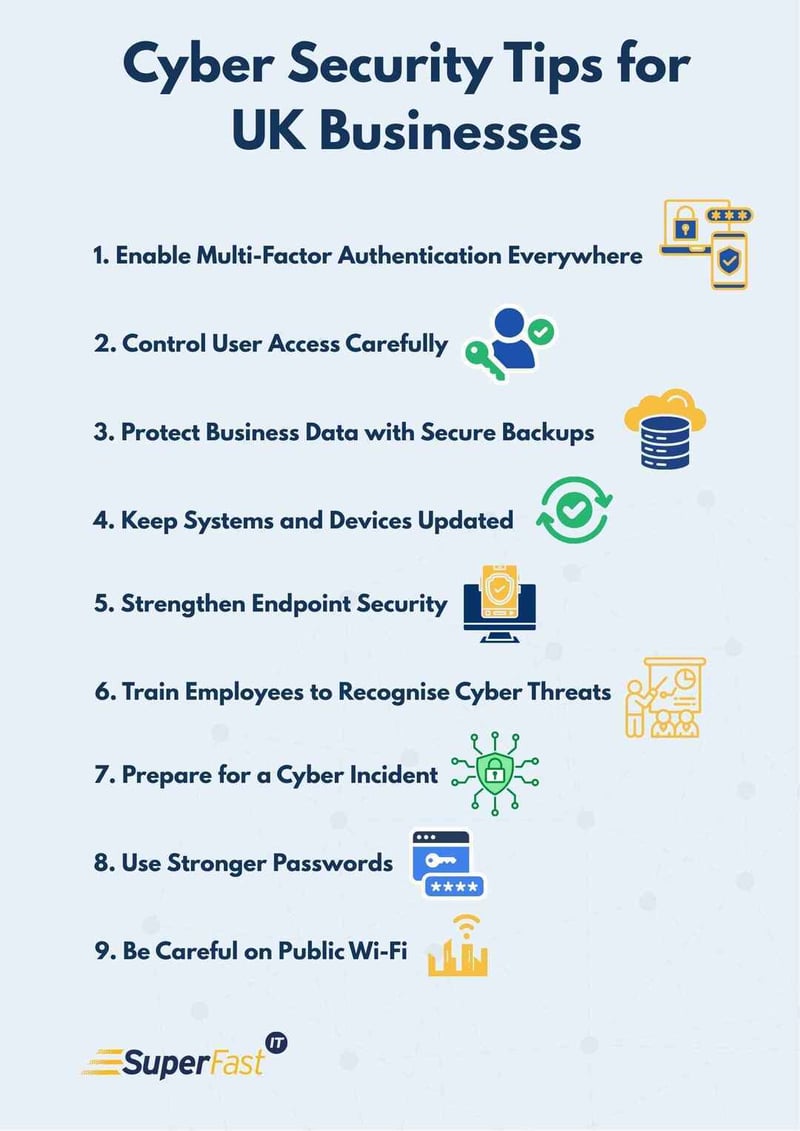
1. Enable Multi-Factor Authentication Everywhere
Passwords alone are no longer sufficient protection for your sensitive data.
Many cyber breaches begin when attackers gain access to login credentials through phishing emails or reused passwords.
Multi-Factor Authentication (MFA) adds a critical layer of protection by requiring an additional verification step, such as a mobile authentication app or biometric check.
You should implement Multi Factor Authentication for:
• Microsoft 365 and email accounts
• Remote access tools
• Finance and payroll systems
• Cloud storage platforms
Enabling MFA across your organisation should be one of the first security improvements implemented, as it provides a strong additional layer of protection against compromised passwords and unauthorised access to online accounts.
2. Control User Access Carefully
Many cyber attacks spread quickly because users have access to more systems and data than they actually need.
Following the Principle of Least Privilege ensures that employees have only the access they require for their roles.
This limits the damage if a user account becomes compromised and helps prevent attackers from moving through your network.
Practical steps include:
• Removing unnecessary administrator privileges
• Restricting access to sensitive folders
• Reviewing permissions regularly
These simple governance improvements can dramatically strengthen your cybersecurity posture as important files should only be accessible by verified individuals.
3. Protect Business Data with Secure Backups
Ransomware remains one of the biggest cyber threats facing UK businesses.
If attackers encrypt your files, a secure and tested backup is often the only reliable recovery method to regain access to sensitive information.
A strong backup strategy should follow the 3-2-1 rule:
• Keep three copies of your data
• Store them on two different media types
• Maintain one secure off-site backup
Importantly, backups should be isolated from your main network so they cannot be encrypted during an cyber attack and data breach.
Regular backup testing is essential. A backup that cannot be restored offers no real protection.
4. Keep Systems and Devices Updated
Outdated software creates vulnerabilities that cyber criminals can easily exploit.
Software updates often include important security patches designed to fix newly discovered weaknesses.
Best practices include:
• Automating operating system updates
• Regularly patching business applications
• Updating firmware on routers and network devices
Proactive monitoring helps identify outdated systems before they become a serious cyber security risk.
5. Strengthen Endpoint Security
Traditional antivirus software alone is no longer enough to defend against modern cyber threats.
Many organisations now use Endpoint Detection and Response (EDR) solutions.
EDR tools monitor device behaviour and can detect suspicious activity, such as unusual file encryption or unauthorised access attempts, even when the threat is previously unknown.
This advanced protection helps stop attacks early and is commonly delivered through managed cybersecurity services offered by many businesses in the UK.
6. Train Employees to Recognise Cyber Threats
Technology can only do so much. Employees play a critical role in preventing cyber incidents.
Phishing emails, malicious links and social engineering attacks rely on human error to succeed.
Regular security awareness training helps employees identify:
• Suspicious emails or attachments
• Fake login pages on fake websites
• Unexpected requests for financial information or sensitive data.
Many organisations also run phishing simulation tests to measure awareness and identify training gaps.
A well-trained workforce becomes a powerful human firewall to help protect against cybercrime and becomes one of the strongest cybersecurity best practices for UK businesses today.
7. Prepare for a Cyber Incident
Even with strong protection in place, every business should assume a cyber incident could happen.
Having a clear incident response plan as an additional security measure ensures your team knows exactly what to do in the event of a data breach.
An effective plan should outline:
• Who to contact internally and externally
• How to isolate affected systems
• Communication plans for staff and customers
• Recovery and investigation procedures
Preparation can dramatically reduce the impact and recovery time of a cyber-attack.
8. Use Stronger Passwords
Weak or reused passwords are among the most common ways cybercriminals gain access to business systems. Using longer passwords made from random words can make them far harder to guess while still being easier for employees to remember.
A password manager can also help staff securely store and generate unique passwords for every account, reducing the risk of password reuse across your organisation.
Best practices:
- Use long passphrases made from random words instead of short, complex passwords
- Ensure every account has a unique password
- Implement a password manager across the business
- Avoid sharing passwords between employees
- Combine strong passwords with Multi-Factor Authentication (MFA)
Creating secure passwords doesn’t need to be complicated—simple steps like longer passphrases and a password manager can dramatically improve your organisation’s security.
9. Be Careful on Public Wi-Fi
Public Wi-Fi networks in places like cafés, airports, and hotels are convenient, but they can also expose your business data to cyber criminals. These networks are often unsecured, making it easier for attackers to intercept information such as login credentials, emails, or sensitive company data.
Using a VPN (Virtual Private Network) helps protect your connection by encrypting your internet traffic. This means that even if someone is monitoring the network, the data they see will be unreadable.
Best practices:
- Avoid accessing sensitive business systems on public Wi-Fi where possible
- Use a VPN when connecting to any public network
- Ensure company devices have up-to-date security and encryption enabled
- Disable automatic Wi-Fi connections on work devices
Taking simple precautions when using public networks can help prevent attackers from gaining access to your organisation’s data.
Cyber Security Tips - Final Thoughts
Cyber threats continue to evolve, but most successful attacks still exploit simple weaknesses such as poor access controls, outdated software, weak backups or untrained staff.
By implementing layered protection and partnering with an experienced IT support and cybersecurity services provider, SMEs can significantly reduce risk while keeping their teams productive and important data safe.
A proactive IT strategy helps businesses:
• Prevent costly downtime
• Protect sensitive business data
• Maintain regulatory compliance
• Operate confidently in a connected world
Proactive IT management and structured cybersecurity controls are increasingly essential for modern businesses that rely on digital systems every day.
Need Help Strengthening Your Cyber Security?
If your organisation would benefit from expert guidance, Superfast IT provides trusted IT support and comprehensive cybersecurity to businesses around the West Midlands.
Our services include:
• Managed IT support
• Cyber security monitoring
• GDPR alignment
• Proactive protection strategies
Book a free consultation today to discuss how we can help protect your people, data and reputation while strengthening your organisation’s cyber security posture.
Related Posts
Cyber Security Poster - Superfast IT
Downloadable Cyber Security Awareness Poster
Download a free cybersecurity poster for your office....
Cyber Security Glossary - Superfast IT
Cyber Security is a new business discipline. Many cyber terms and phrases sound alien as they have...
Downloadable Cyber Security Email Campaign Template for Businesses
Download our Cyber Security email campaign template! The email templates are designed to raise...